God’s empty chair
On the Road“God’s empty chair” is Dean Moriarty’s description of the piano seat left vacant after George Shearing’s performance at Birdland. The expression makes absence part of the music’s force: for Dean, the empty place marks the departure of a near-divine presence, while the surrounding scenes of improvisation give that presence a distinctly collective, physical form.
The phrase at Birdland
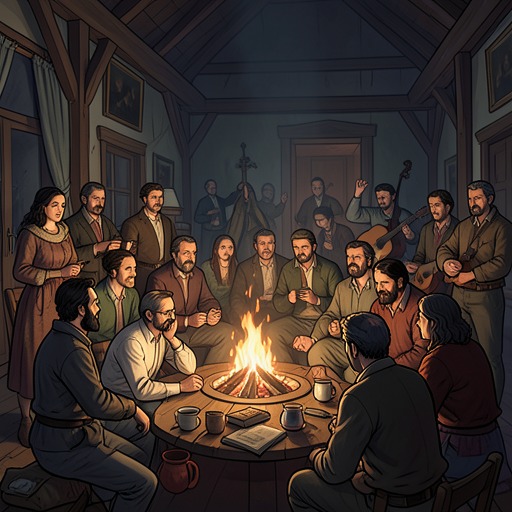
At the club, Dean and Sal Paradise arrive early to hear Shearing, the blind English pianist, play. His performance gathers momentum through repeated chords, an accelerating beat, and the pianist’s increasingly intense movement: he rocks in his seat, bends toward the keys, pushes back his hair, and sweats. As the music swells, listeners call for him to continue; Dean, sweating too, hails him as “Old God Shearing.” The performance is not presented as a detached display of virtuosity. Its rhythm draws musician, audience, and listener into one charged occasion. When Shearing leaves the piano, Dean points to the vacant seat and calls it “God’s empty chair.” The naming follows the performance rather than explaining it in advance: the chair becomes significant because the music has made the pianist’s presence feel larger than the person who produced it. A horn rests on the piano, its golden shadow falling across a painted desert caravan. The scene then turns from sound to silence. The narration describes the silence as the departure of God, while Dean remains wide-eyed with awe.
Music, presence, and IT
The phrase belongs to a larger effort to describe what Dean calls IT: the quality an improviser reaches when a performance seems to answer what everyone present is waiting for. On the journey east from San Francisco, Dean explains that a musician begins with a chorus, develops ideas, and may suddenly “get it”; at that point, listeners recognize the change, and time seems to stop. His account makes IT more than technical command. The musician gives form to shared feeling by filling musical space with remembered ideas and present emotion. The later account of young musicians in Chicago extends this idea beyond any single performer. After Shearing’s choruses leave the audience in awe, the musicians continue playing; they search for new phrases, find and lose them, and struggle toward a tune that might raise listeners to joy. The effort does not end with one triumphant performance. In this context, the empty chair is not simply a monument to Shearing. It marks a momentary arrival that cannot be possessed, followed by the renewed labor of listening and improvising.
A recurring image of jazz community
The phrase’s religious language gives Dean a way to register the intensity of performance, but the scene locates that intensity among people: in the bass player’s pulse, the drummer’s brushes, the pianist’s chords, the audience’s cries, and Dean’s own responses. A separate night in a rough San Francisco club offers a more crowded version of the same musical fellowship. A tenor player stretches a rising-and-falling riff while the crowd urges him onward, a drummer drives the beat, and dancers and listeners move with the sound. The music’s force depends on performance and response together, not on an isolated genius alone. Dean’s language also gives musical experience a mythic scale without making it permanent. At Birdland the revelation gives way to silence; in Chicago, players resume their search after Shearing has left the stand. “God’s empty chair” holds both sides of that pattern in a single image: the extraordinary presence music can create, and the vacancy that remains when the performance ends. The phrase distills the book’s recurring association between jazz improvisation, IT, and the hope of briefly making a shared life audible.